Send us message to learn more about InnoHK
CONTACT US
Artificial Intelligence
AI Chip Center for Emerging Smart Systems
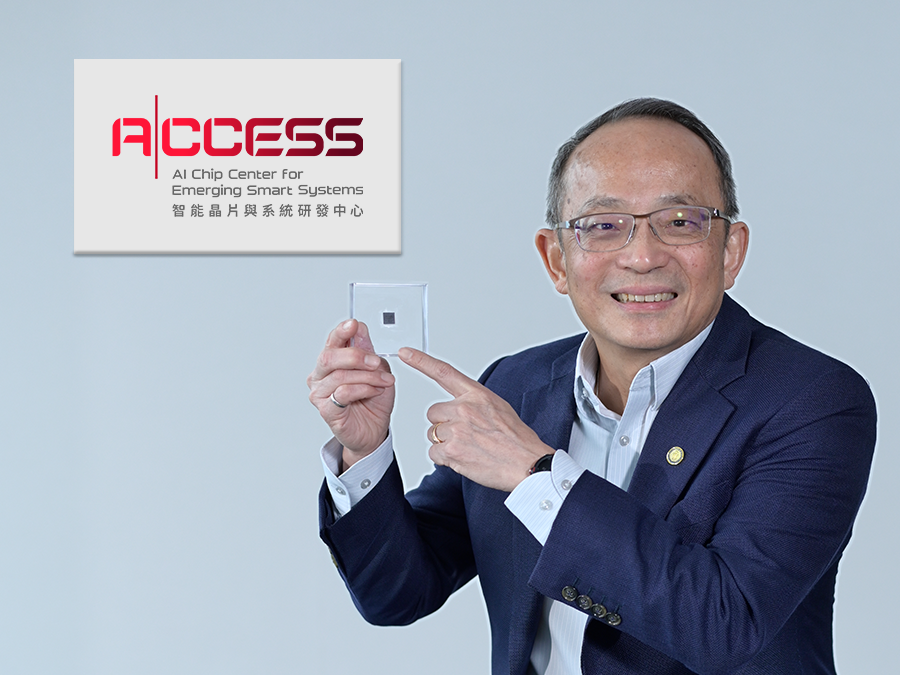
Developing AI Chips for the New Data-centric Computing Paradigms


We recognise that specialised AI chips will be a key factor driving the AI revolution. Our team of world-class experts are designing customised AI hardware that will support more innovative applications, and complement other AI research projects in the region. We will not only advance Hong Kong to become a major player on the world stage in AI chip and hardware design, but also create a conducive environment for nurturing a large pool of AI hardware talent that will support the AI chip design industry.
Professor Tim Cheng
Center Director;
Vice-President for Research and Development, HKUST
Developing AI Chips for the New Data-centric Computing Paradigms
The proliferation of artificial intelligence (AI) applications such as autonomous vehicles, medical diagnosis and video image analytics has fuelled the transformation of many industries. The introduction of specialised AI chips makes training and running AI models much more efficient and effective. These specialised AI chips allow AI tasks to run faster and consume less power than general-purpose chips. According to a recent Research and Markets report[1], the global AI device market is forecasted to grow at a CAGR of 42% from 2020–2024 reaching a value of US$54.03 billion.
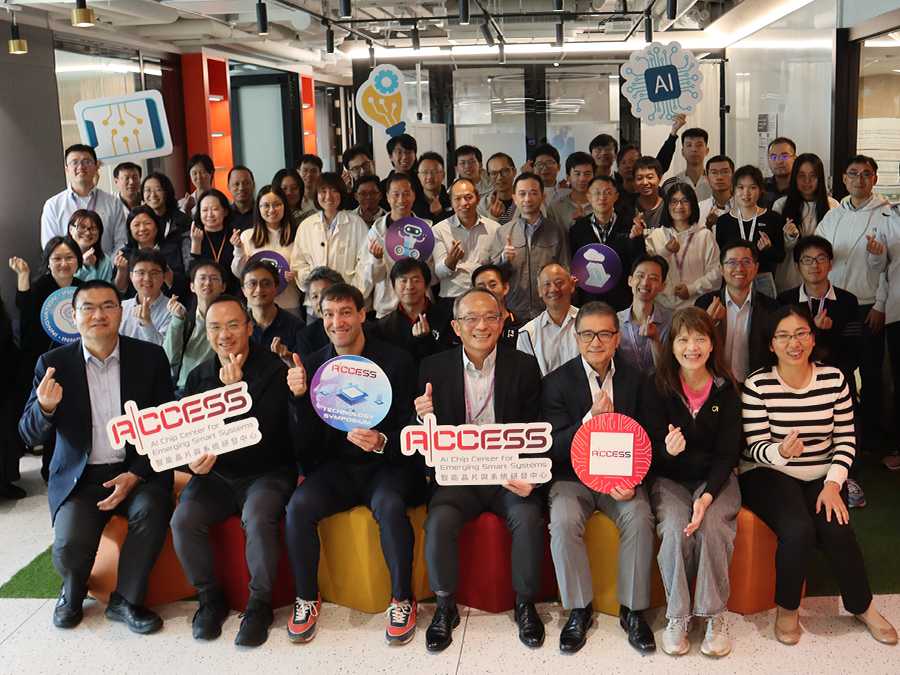
ACCESS is a multi-disciplinary center, which will focus on research of designing customized AI chips to realise ubiquitous AI applications.
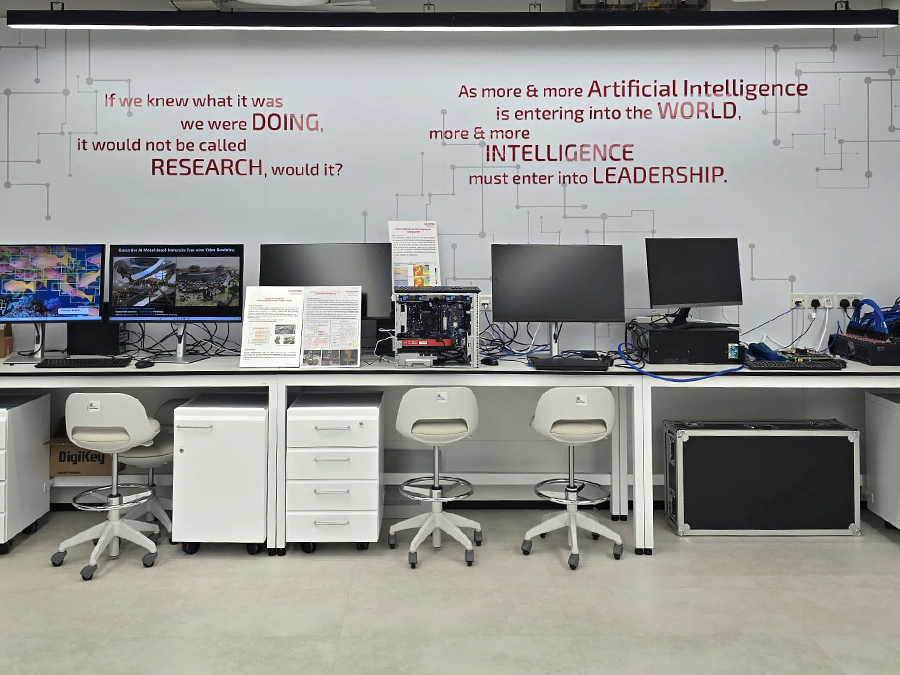
Collaboration spaces are designed for our experts and talents to meet and work.
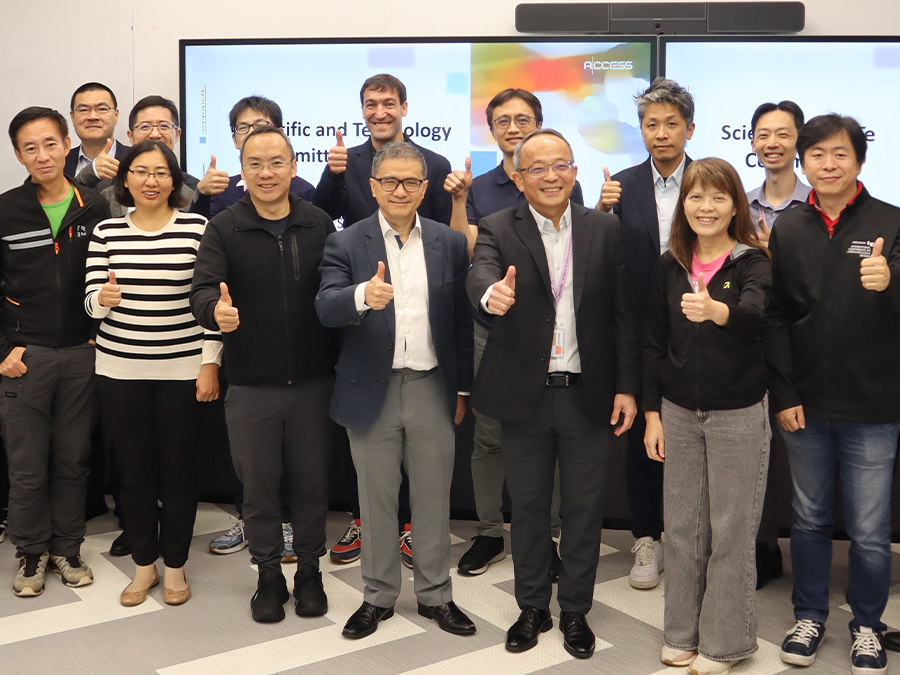
ACCESS colleagues work closely for AI chip and hardware design collaboration and research.
To cope with this emerging demand on hardware, the AI Chip Center for Emerging Smart Systems (ACCESS) is putting Hong Kong on the global map of AI chip and hardware design. ACCESS is a tightly coordinated, multi-disciplinary center for advancing integrated circuit (IC) design technologies to enable novel data-centric computing paradigms supporting a wide range of AI applications. The Center will focus on the research theme of designing customised AI chips to realise ubiquitous AI applications used throughout society.
The research agenda in ACCESS is organised into four programmes:
- Computing-in-Memory Architecture for Large-scale AI Models: Tackling the compute, memory, and memory bandwidth scaling problems, particularly focusing on advancing CIM-based chip architecture to enable the ultra-energy-efficient and scalable deployment of large-scale AI models.
- Hardware-Software Co-Design for Energy-Efficient and High-Performance Edge AI: Advancing the field of algorithm-hardware co-design, addressing new challenges arising from the increasing complexity, scalability, energy efficiency, and latency requirements of embodied large-scale AI applications.
- EDA (Electronic Design Automation) for Large-Scale AI Hardware: Exploring new frontiers in EDA for AI chip and system design, with the primary focus placed on supporting the chiplet- and 3DIC-based designs, overcoming the limitations of existing EDA tools, and exploring the employment of foundation AI models in various design tasks to enable more agile chip design.
- Cross-layer Optimization and Demonstration for Targeted Applications: Leveraging the technologies developed in the above 3 research projects to perform cross-layer optimization and develop hardware-accelerated working systems for domain-specific, large-scale AI applications with revolutionary performance.
Project team members
-
 Professor Tim Cheng
Center Director;
Vice-President for Research and Development, HKUST -
 Dr. Luhong Liang
Executive Director
In this project
You may also like

AI & Robotics
Centre for Artificial Intelligence and Robotics, Hong Kong Institute of Science & Innovation, Chinese Academy of Sciences
OUR TEAM
Artificial Intelligence
AI Chip Center for Emerging Smart Systems
OUR TEAM
Professor Tim Cheng, Dr. Luhong Liang

